A Complete Learning Framework for DevOps, AIOps, MLOps, and DataOps
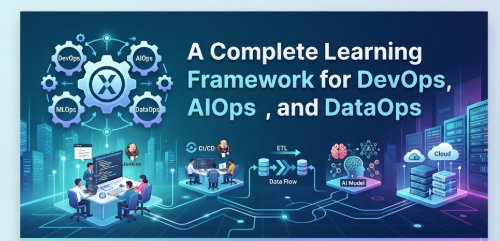
Modern technology teams face a unique challenge: systems have grown exceptionally complex. Software applications no longer run on a single server managed by one team. Instead, modern digital infrastructure spans distributed cloud environments, automated software delivery pipelines, massive data streams, machine learning models, artificial intelligence services, strict security frameworks, and careful cost management.
Because these systems are deeply interconnected, managing them in isolated silos creates friction. Development teams write code, but operations teams manage infrastructure. Data engineers build pipelines, while machine learning specialists focus purely on model training. Security teams review code after deployment, and financial specialists try to control cloud costs after the bills arrive.
To solve this fragmentation, modern organizations are shifting toward an integrated approach known as XOps. Rather than treating each operational discipline as a separate entity, XOps acts as an umbrella framework that connects diverse operational practices.
This comprehensive guide explores what XOps means, why it matters, the major disciplines it encompasses, commonly used tools, and how platforms like XOpsSchool serve as valuable educational resources for learners looking to build practical, modern technical skills.
What is XOps?
At its core, What is XOps is one of the most common questions asked by modern technology professionals. Simply put, XOps is an umbrella approach that brings together multiple operational practices across software delivery, data, artificial intelligence, machine learning, security, reliability, and infrastructure.
The letter "X" represents a variable—standing for different operational domains. While traditional practices often treated DevOps, DataOps, and MLOps as completely separate operational worlds, XOps recognizes that these disciplines share common foundations. They all rely on automation, continuous feedback loops, infrastructure as code, observability, and structured workflows.
By connecting these operational areas, organizations can break down internal barriers. XOps is not a single software tool, a specific hardware device, or a quick-fix product. It is an operational philosophy and methodology that encourages collaboration, standardization, and continuous improvement across the entire technology lifecycle.
Why XOps Matters in Modern IT
As organizations accelerate their digital transformation, infrastructure operations face unprecedented demands. Applications must remain online constantly, data pipelines must process millions of records reliably, machine learning models must update smoothly, and security vulnerabilities must be addressed proactively.
When teams operate in silos, several challenges emerge:
- Operational Blind Spots: Teams lack visibility into how changes in one area (such as a database update) affect another area (such as a machine learning model inference).
- Communication Gaps: Hand-offs between developers, data engineers, and security specialists create delays and misunderstandings.
- Tool Fragmentation: Using dozens of disconnected tools without a unified operational strategy leads to maintenance overhead and inefficiency.
- Reactive Problem Solving: Organizations spend more time fighting fires than building preventive automation and robust monitoring.
XOps thinking addresses these challenges by encouraging shared operational practices. It promotes automation so that routine tasks do not require manual intervention. It emphasizes observability so teams can detect and resolve issues before they impact end users. Ultimately, XOps helps organizations build resilient, scalable, and manageable technology environments.
Major XOps Disciplines
To truly understand XOps, it is helpful to examine the major operational disciplines that fall beneath its umbrella. Each discipline focuses on a specific domain while sharing common automation and reliability principles.
DevOps
DevOps focuses on the cultural and technical practices that bridge software development and IT operations. It emphasizes continuous integration and continuous delivery (CI/CD), infrastructure automation, containerization, and faster feedback loops between writing code and deploying it to production.
DataOps
DataOps applies agile and automated practices to data engineering. It focuses on building reliable data pipelines, maintaining data quality, orchestrating data workflows, and ensuring that data flows smoothly and accurately from source systems to analytical platforms.
MLOps
MLOps bridges machine learning development with operational deployment. It covers model lifecycle management, version control for data and models, automated testing, continuous training, and production monitoring to ensure models remain accurate over time.
AIOps
AIOps leverages artificial intelligence and machine learning to improve IT operations. It helps organizations analyze massive volumes of operational data, detect anomalies, correlate alerts, reduce alert fatigue, and automate incident remediation.
SecOps
SecOps integrates security practices directly into operational workflows. Rather than treating security as a final review step, SecOps ensures that security scanning, compliance checks, and vulnerability management happen continuously throughout the development and deployment lifecycle.
FinOps
FinOps brings financial accountability to cloud-native operations. It helps engineering, finance, and business teams collaborate to understand, monitor, and optimize cloud spend without sacrificing performance or velocity.
XOps Training
Building expertise across multiple operational domains requires structured learning. Comprehensive XOps Training programs are designed to help professionals transition from isolated technical tasks to holistic operational management.
A well-structured training pathway typically covers:
- XOps Fundamentals: Understanding the umbrella concept, core principles, and how different operational disciplines connect.
- DevOps Foundations: Mastering source control, CI/CD pipelines, containerization, and infrastructure automation.
- Cloud Infrastructure: Learning how modern cloud platforms operate, including networking, compute, storage, and IAM policies.
- Observability and Reliability: Studying metrics, logs, traces, alerting thresholds, and incident response frameworks.
- Specialized Operational Areas: Exploring DataOps pipelines, MLOps model management, and AIOps event handling.
- Governance and Security: Understanding how to embed security and cost management into daily operational workflows.
Platforms like XOpsSchool provide educational resources and structured learning paths that help students and working professionals understand these core concepts clearly and methodically.
XOps Certification
Technical certifications are popular among IT professionals seeking to validate their knowledge. Preparing for an XOps Certification encourages learners to study structured syllabi, test their understanding through practice questions, and identify knowledge gaps in their technical background.
It is important to remember that certification alone does not equal practical expertise. True proficiency comes from hands-on practice, building projects, and troubleshooting real operational problems. However, certification preparation provides a structured roadmap for organizing complex technical topics and demonstrating a foundational familiarity with modern operational concepts.
XOps Course
Choosing the right XOps Course is an important step for anyone looking to deepen their technical skills. A high-quality educational course should follow a logical progression, moving from fundamental concepts to advanced operational integrations.
An ideal course syllabus often includes:
- Introduction to modern IT operations and the XOps framework.
- Core DevOps principles, Git workflows, and CI/CD automation.
- Containerization with Docker and orchestration using Kubernetes.
- Infrastructure as Code (IaC) using declarative automation tools.
- Observability principles, monitoring tools, and reliability engineering.
- Data operations, pipeline orchestration, and data quality assurance.
- Machine learning lifecycle operations and model monitoring.
- AI-driven operations and anomaly detection concepts.
- Security integration, compliance, and cloud cost governance.
- Final synthesis connecting multiple operational domains into a unified workflow.
Learners should choose course depth according to their existing technical background, ensuring they grasp foundational concepts before exploring advanced specializations.
XOps Tutorial
Practical learning is essential for mastering technical concepts. An effective XOps Tutorial guides learners through hands-on exercises, helping them understand how theory translates into real-world configuration and execution.
Tutorials help learners understand:
- Setting up automated CI/CD pipelines for software applications.
- Configuring container clusters and deploying microservices.
- Writing declarative infrastructure scripts for cloud environments.
- Establishing monitoring dashboards and setting up meaningful alerts.
- Building basic data pipelines and testing data quality.
- Managing machine learning model deployments and tracking performance metrics.
Reading a tutorial provides conceptual clarity, but experimenting in a sandbox or lab environment builds the muscle memory required for professional operational work.
XOps Tools
XOps is not a single tool, but various technologies support XOps workflows across different domains. Understanding how these tools fit into operational pipelines is a key part of technical education.
Source Control and Versioning
Platforms like Git, GitHub, and GitLab form the foundation of collaborative engineering, enabling teams to track code changes, manage contributions, and trigger automated workflows.
CI/CD Automation
Tools such as Jenkins, GitHub Actions, and GitLab CI/CD automate the process of building, testing, and deploying software applications reliably.
Containers and Orchestration
Docker provides lightweight containerization, while Kubernetes manages container deployment, scaling, and networking across distributed clusters.
Infrastructure Automation
Terraform and Ansible allow teams to provision cloud infrastructure and manage system configurations using code rather than manual processes.
Observability and Monitoring
Prometheus, Grafana, and OpenTelemetry help engineering teams collect metrics, logs, and traces to monitor system health and troubleshoot performance bottlenecks.
Data and Model Operations
Specialized orchestration tools manage data pipelines, while MLOps platforms handle model versioning, artifact storage, and performance tracking.
Tool selection should always depend on architectural requirements, team skills, security constraints, and organizational scale rather than blindly following industry trends.
DevOps Training
DevOps remains a critical foundational pillar within the broader XOps landscape. Effective DevOps Training focuses on automating software delivery, establishing robust CI/CD pipelines, containerizing applications, and managing infrastructure through code.
While DevOps primarily targets the software development and deployment lifecycle, mastering these fundamentals provides the necessary technical grounding required to explore advanced operational areas like DataOps, MLOps, and platform engineering.
AIOps Training
As system complexity outpaces human monitoring capabilities, artificial intelligence plays an increasingly vital role in IT operations. AIOps Training helps professionals understand how machine learning models can analyze log streams, detect anomalies, correlate disparate alerts, and reduce noise during critical incidents.
Learning AIOps involves understanding how to feed operational data into intelligent systems while recognizing that human judgment and domain expertise remain essential for root-cause analysis and complex decision-making.
MLOps Training
Deploying machine learning models into production introduces unique engineering challenges that traditional software deployment does not fully address. MLOps Training covers the entire machine learning lifecycle, including data versioning, model training automation, validation testing, deployment strategies, and ongoing performance monitoring.
By combining data science with rigorous software engineering practices, MLOps ensures that machine learning models deliver reliable, reproducible business value in production environments.
DataOps Training
Data drives modern decision-making, but unreliable data pipelines can derail analytics and machine learning initiatives. DataOps Training focuses on applying agile principles, automated testing, and continuous delivery to data engineering.
Learners study how to build resilient data pipelines, enforce data quality standards, orchestrate complex data workflows, and monitor data health to ensure stakeholders receive accurate, timely information.
How XOps Connects DevOps, DataOps, MLOps, and AIOps
To understand XOps fully, it helps to examine how these individual disciplines interact within an organization:
- DevOps ensures that application code moves smoothly from development to production through automated testing and deployment pipelines.
- DataOps ensures that analytical and operational data flows reliably through tested, monitored pipelines without quality degradation.
- MLOps ensures that machine learning models are trained, packaged, deployed, and monitored with the same rigor applied to software applications.
- AIOps applies intelligence back into the operational ecosystem, helping teams monitor system health and automate incident responses across DevOps, DataOps, and MLOps environments.
Rather than operating in isolation, these disciplines share common infrastructure, observability standards, security policies, and automation practices. This unified approach eliminates friction and accelerates overall organizational delivery.
Who Can Benefit from XOpsSchool?
Learning resources provided by platforms like XOpsSchool cater to a diverse audience of technology professionals and learners.
1. DevOps and Cloud Engineers
Cloud and DevOps professionals can broaden their technical scope beyond traditional software delivery and infrastructure management, exploring how data workflows and machine learning operations integrate with core cloud systems.
2. Data Engineers
Data engineers can leverage DataOps concepts to improve pipeline reliability, implement automated testing, enhance data observability, and establish robust monitoring practices for enterprise data streams.
3. Machine Learning Professionals
Machine learning practitioners can utilize MLOps training to connect their model development work with reliable deployment pipelines, automated validation testing, and production monitoring tools.
4. IT Operations and SRE Professionals
Site Reliability Engineers and traditional operations professionals can explore AIOps, advanced observability, automation, and platform engineering concepts to modernize their operational skill sets.
5. Developers and Technical Learners
Software developers can gain a deeper understanding of the operational side of modern applications, learning how code behaves in production, how infrastructure is provisioned, and how systems are monitored.
6. Technology Teams and Organizations
Engineering leaders and technical teams can use XOps knowledge to align their strategies, breaking down departmental silos between development, infrastructure, data, AI, security, and financial governance.
Common Mistakes When Learning XOps
When approaching XOps education, learners sometimes encounter common pitfalls:
- Treating XOps as a Single Tool: Expecting to download one piece of software that magically solves all operational challenges.
- Learning Tools Without Concepts: Memorizing command-line syntax for a specific tool without understanding the underlying architectural principles.
- Trying to Learn Everything Simultaneously: Attempting to master DevOps, DataOps, MLOps, SecOps, and FinOps all at once rather than following a progressive path.
- Ignoring Foundations: Skipping fundamental Linux, networking, and version control concepts before jumping into advanced automation.
- Focusing Solely on Certification: Treating exam preparation as the ultimate goal rather than building genuine practical competence.
- Neglecting Observability: Building complex automation pipelines without implementing proper logging, metrics, and tracing.
Learners can avoid these mistakes by starting with fundamentals, focusing on conceptual understanding before tool selection, and practicing hands-on integration.
Best Practices for Learning XOps
To build sustainable, long-lasting expertise in modern IT operations, follow these proven learning habits:
- Build a strong foundation in Linux, networking, and version control.
- Master core DevOps principles before exploring specialized domains like MLOps or DataOps.
- Practice infrastructure as code to understand automated provisioning.
- Learn observability fundamentals by setting up monitoring and alerting in test environments.
- Build small, integrated projects that combine application deployment with basic data or monitoring workflows.
- Read documentation, architectural guides, and real-world post-mortems to understand how production systems fail and recover.
8-Step XOps Learning Guide
Step 1: Understand What XOps Means
Familiarize yourself with the core philosophy of connected IT operations, learning how various operational disciplines work together under a unified umbrella.
Step 2: Build DevOps Foundations
Master version control with Git, basic Linux administration, scripting, and continuous integration pipelines.
Step 3: Learn Cloud and Infrastructure
Study cloud computing fundamentals, networking basics, declarative infrastructure provisioning, and containerization using Docker.
Step 4: Learn Observability and Reliability
Understand how to collect metrics, logs, and traces, set up monitoring dashboards, define SLIs and SLOs, and manage incident responses.
Step 5: Explore DataOps
Learn how data flows through pipelines, how data quality is validated, and how orchestration tools manage continuous data delivery.
Step 6: Explore MLOps and AIOps
Study the machine learning lifecycle, model deployment practices, and how artificial intelligence assists with IT monitoring and event correlation.
Step 7: Learn Security, Governance, and Cost Awareness
Understand SecOps practices, compliance frameworks, and FinOps cloud cost management principles.
Step 8: Build an Integrated Practical Project
Combine several operational disciplines into a cohesive, hands-on project to experience how different workflows interact in practice.
Practical XOps Learning Approach
Moving from theory to practical expertise requires active experimentation. Learners should set up local lab environments or cloud sandbox accounts to test configuration files, build CI/CD pipelines, provision infrastructure using code, and deploy monitoring agents.
Simulating minor failures—such as breaking a pipeline or misconfiguring a container—and practicing troubleshooting builds the problem-solving resilience required in professional IT operations.
How to Choose XOps Tools
When evaluating technologies for operational workflows, consider the following criteria:
- Business Requirements: Does the tool solve a specific operational problem your team faces?
- Architectural Fit: Does the tool integrate smoothly with your existing technology stack?
- Team Skills: Can your team learn and maintain the tool effectively without excessive overhead?
- Scalability and Security: Does the tool meet enterprise security standards and scale as your organization grows?
- Community Support: Is the tool actively maintained with robust documentation and community resources?
Choosing tools solely because they are popular often leads to adoption friction and maintenance challenges.
XOps Career and Skill Development
Developing XOps knowledge enhances professional versatility across multiple technical roles. Rather than locking yourself into a single narrow domain, understanding connected operations allows you to collaborate effectively with developers, data scientists, security specialists, and financial stakeholders.
While technical ability and hands-on experience are crucial, strong communication, problem-solving skills, and a willingness to embrace continuous learning remain essential for long-term professional growth in modern IT operations.
Using XOpsSchool as a Learning Resource
Approaching a comprehensive learning platform effectively requires a structured strategy. Readers can utilize XOpsSchool by following these steps:
- Begin with fundamental guides to understand the broader XOps landscape.
- Identify the specific operational discipline that aligns closest with your current career role or professional interest.
- Study the relevant tools and conceptual frameworks associated with that discipline.
- Use platform tutorials to clarify specific technical configurations.
- Explore related operational domains to broaden your overall understanding of connected IT systems.
- Utilize structured learning paths and certification resources to organize your revision and test your knowledge.
Frequently Asked Questions
1. What is XOps in simple terms?
XOps is an umbrella approach that connects multiple operational disciplines—such as DevOps, DataOps, MLOps, and SecOps—under a unified framework of automation, collaboration, and reliability.
2. How is XOps different from DevOps?
While DevOps focuses primarily on software development and infrastructure delivery, XOps expands upon this by integrating data operations, machine learning workflows, artificial intelligence monitoring, security, and cost governance into a broader operational strategy.
3. What disciplines are included in XOps?
XOps commonly encompasses DevOps, DataOps, MLOps, AIOps, SecOps, FinOps, and platform engineering.
4. Is XOps suitable for beginners?
Yes, beginners can learn XOps by starting with foundational IT concepts like Linux, networking, and basic version control before progressing to advanced automation and specialized operational domains.
5. What should an XOps training path include?
A robust training path should cover DevOps foundations, cloud infrastructure, observability, automation, data operations, machine learning lifecycle management, and security governance.
6. What is the purpose of XOps certification?
Certifications help learners organize their study material, test their foundational knowledge, and demonstrate a structured understanding of modern operational concepts to peers and employers.
7. What should learners look for in an XOps course?
An effective course should offer a logical progression from beginner fundamentals to advanced multi-disciplinary workflows, emphasizing practical understanding and conceptual clarity.
8. Which tools are commonly associated with XOps?
Commonly used tools include Git, Jenkins, GitHub Actions, Docker, Kubernetes, Terraform, Ansible, Prometheus, Grafana, and various pipeline orchestration platforms.
9. How are DevOps, DataOps, MLOps, and AIOps connected?
They share common operational principles such as automation, infrastructure as code, CI/CD pipelines, and observability, allowing organizations to manage diverse technical workloads cohesively.
10. How can someone start learning XOps?
Learners can start by understanding core DevOps principles, exploring cloud infrastructure basics, practicing automation through tutorials, and utilizing structured educational platforms like XOpsSchool to guide their learning journey.
Conclusion
Modern IT operations require more than isolated technical skills. As systems grow increasingly complex across cloud, data, and artificial intelligence domains, organizations need a unified operational strategy. XOps provides this holistic framework, connecting DevOps, DataOps, MLOps, AIOps, and other specialized disciplines through shared automation, observability, and collaboration.
By focusing on foundational principles, hands-on practice, and continuous learning, professionals can master modern operational workflows. Educational platforms like XOpsSchool serve as valuable resources for learners seeking to understand these interconnected technologies and build sustainable, practical skills for the future of IT operations.