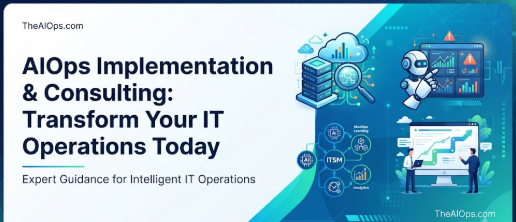
AIOps Implementation & Consulting: Transform Your IT Operations Today
Imagine your favorite video game or online school portal as a giant, bustling amusement park. In this park, thousands of little roller coasters zoom around every single second, ticket booths print out papers, and bright neon lights twinkle in the sky.
Now, imagine trying to watch every single roller coaster, ticket printer, and flashing light all by yourself with a magnifying glass. Your eyes would get super tired, right?
That is why smart digital caretakers use a wonderful helper. This helper uses clever computer magic to watch everything at once, spot when a roller coaster slows down, and fix the hiccup before anyone even notices. This amazing digital friend is called Artificial Intelligence for IT Operations, or AIOps for short!
What It Is
Think of AIOps as a super-smart robot brain that lives inside big computer systems.
Back in the old days, computer helpers had to look at long, boring lists of error codes by hand. It took hours of hard work, and people easily missed tiny mistakes.
Today, this modern helper looks at giant piles of digital clues—like system logs, performance metrics, and network traces—faster than you can blink your eyes. It connects the dots between a slowdown in one corner of the park and a glitch in another, turning confusing noise into clear, simple answers.
Why Its Matter
Why should anyone care about this robot brain? Imagine your favorite online cartoon website freezing right in the middle of the funniest part. That makes everyone sad and grumpy!
Computers run our modern world, from digital homework books to online toy shops and video apps. When they break down, life gets messy.
Using this smart approach helps keep digital playgrounds open and running smoothly all day and all night. It stops tiny computer hiccups from turning into giant monster problems, saving time, energy, and a whole lot of stress for everyone involved.
All Details About the Smart Computer World
To truly understand how this magical digital helper works, we have to look at all its different pieces. Every single part plays a special role in keeping the computer city safe and happy.
AIOps Training
Before anyone can build or look after a smart computer helper, they need to learn the secret rules. AIOps Training teaches people how to set up intelligent monitoring systems, catch strange computer behaviors early, and design automated fixes. It gives learners hands-on practice so they can become true masters of digital systems.
AIOps Certification
How do you prove you are a top-notch computer helper expert? You earn a shiny gold star! Structured AIOps Certification programs test your knowledge and give you official proof that you know how to manage smart operational systems, handle big data, and keep networks healthy.
AIOps Course
An in-depth AIOps Course is like a wonderful storybook school adventure. It guides students step-by-step through the fundamentals, core technologies, system architectures, and real-world challenges. You learn how everything fits together from the ground up.
AIOps Consulting
Sometimes, big organizations look at their messy computer rooms and scratch their heads. That is when expert guidance comes in handy. AIOps Consulting brings in wise advisors who look at existing setups, find the tricky bottlenecks, and draw out a clear map for a smoother journey.
AIOps Services
Having a brilliant plan is wonderful, but someone has to do the heavy lifting. AIOps Services help organizations integrate modern technologies, clean up messy data streams, and build reliable digital environments that never let users down.
AIOps Tools
You cannot build a treehouse without hammers and nails! The market is filled with wonderful AIOps Tools designed for monitoring, observability, incident management, and data analytics. These tools gather signals from every corner of the network and turn them into useful actions.
AIOps Platform
Imagine putting all your favorite toys into one big, tidy toy box instead of leaving them scattered across the floor. An AIOps Platform does exactly that. It acts as a central command center where all operational data comes together, cutting down on confusing alert noises and showing you the exact source of trouble.
AIOps Implementation
Moving from old-fashioned, messy monitoring to smart, proactive operations is called AIOps Implementation. This journey involves gathering data streams, setting normal behavior baselines, introducing safe automation, and watching your digital world run like clockwork.
Artificial Intelligence for IT Operations
At the very heart of this entire universe is Artificial Intelligence for IT Operations. By mixing machine learning algorithms with everyday computer tasks, systems can learn from past mistakes and make smart choices on their own.
AIOps Engineer
Every great spaceship needs a brave captain. An AIOps Engineer is the brilliant person who designs, builds, and looks after these intelligent systems. They combine training, tools, and hands-on courses to make sure technology serves people safely and efficiently.
Benefits
Using a smart operational assistant brings wonderful gifts to any organization:
- Lightning Speed: Finding and fixing computer bumps happens almost instantly instead of taking hours.
- Quiet Peace: Instead of getting a million confusing warning bells, teams get one clear message about what actually needs attention.
- Happier Friends: Websites and apps stay open and fast, meaning no more frustrating loading screens.
- Smart Savings: Resources are used wisely so that computers do not waste energy or money.
Step Process
Building a smart computer helper happens in clear, easy stages:
- Collecting Clues: Gather logs, metrics, and event traces from every single computer and application in the network.
- Tidying Up: Sort through the pile, throw away duplicate messages, and put everything into a neat order.
- Spotting Trends: Use machine learning models to figure out what normal computer behavior looks like.
- Connecting the Dots: Link related alerts together to discover the true root cause of a problem.
- Taking Quick Action: Trigger automated fixes or send clear, prioritized notes to the human engineering team.
Common Mistakes
Even smart teams can trip up if they are not careful. Watch out for these little traps:
- Skipping the Foundation: Trying to build advanced automation before cleaning up your basic data collection.
- Forgetting Humans: Trusting the robot brain completely without keeping human engineers in the loop to check important choices.
- Buying Too Many Gadgets: Collecting too many disconnected tools instead of using a unified platform.
- Neglecting Learning: Expecting staff to use new systems without giving them proper learning paths and courses first.
Frequently Asked Questions
What does AIOps stand for?
It stands for Artificial Intelligence for IT Operations. It means using smart computer brains to look after other computers.
Why do companies need an AIOps platform?
Because modern computer systems are too big for humans to watch manually. A platform brings all data together into one tidy place.
How does anomaly detection work?
The smart system learns what normal computer behavior looks like over time and raises a gentle flag whenever something looks strange.
Can AIOps fix problems all by itself?
Yes! Through automated remediation, trusted systems can restart crashed services or scale up resources safely without waiting.
Do I need special training to use these tools?
Taking an organized course or earning a certification helps you understand how to configure and manage these powerful systems correctly.
What is root-cause analysis?
It is the detective work of finding the exact underlying reason why a computer error happened, rather than just treating surface symptoms.
Does this replace human computer engineers?
Not at all! The smart helper takes care of boring repetitive tasks so human engineers can focus on creative building.
How do I get started with implementation?
Begin by assessing your current tools, identifying your biggest bottlenecks, gathering clean data, and starting with simple automation.
Is big data important for this process?
Very important! Smart systems need to look at large streams of metrics, logs, and traces to recognize hidden patterns.
How does it reduce alert noise?
It groups hundreds of related warning messages together into a single meaningful incident so teams do not get overwhelmed.
Conclusion
Managing modern computer systems does not have to feel like an impossible puzzle. By embracing intelligent automation, clean data practices, and smart operational tools, organizations can keep their digital worlds running smoothly, happily, and reliably. Whether you are studying for your first certification, exploring consulting options, or building a brand-new career path, stepping into this exciting ecosystem opens the door to a bright and successful future.