Three Ways to Use NoOpsSchool for Learning, Adoption and Hiring in Automated IT Operations
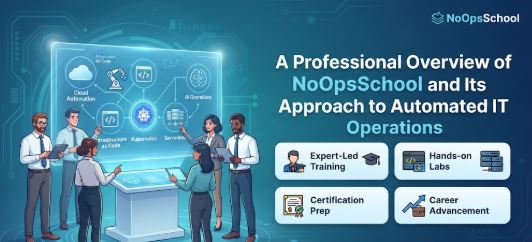
People come to automation with very different needs. An engineer wants a clear route to a recognized qualification. A company wants to cut manual work without risking its systems. A hiring manager wants to find someone who can truly build what the team needs. NoOpsSchool is an India-based education, certification and consulting platform that serves an international English-speaking technical audience, and its offerings can be read from each of these viewpoints. This guide follows three paths, then goes deeper into the technical ideas that sit behind them. It is written to be practical, honest about limits and useful whether you are exploring NoOps certification for yourself or planning a larger program.
The NoOps Idea in Brief
Before choosing a path, it helps to share a common starting point. People who ask what is NoOps are usually looking for a short and honest answer. NoOps is a way of running IT systems in which routine operational work is turned into automation, so people rarely need to perform it by hand. Servers are created from code, software moves to production through pipelines, and monitoring can trigger fixes for known problems.
Two cautions belong in every discussion of the idea. First, the name is a direction, not a literal promise. Systems still need owners, security still needs attention and unusual failures still need human judgment. Second, NoOps is not a rival to DevOps. In the NoOps vs DevOps debate, the more accurate picture is that DevOps built the culture of shared responsibility, and NoOps pushes automation further into the daily running of the platform.
Choosing Your Path Thro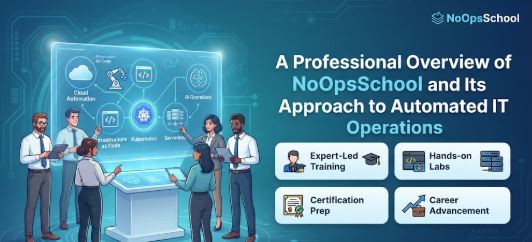 ugh the Platform
NoOpsSchool describes four main areas: training courses, certification programs, consulting and access to freelance specialists. Each area serves a different reader.
- Learners will mostly use the training and certification programs.
- Organizations will weigh training for their staff against consulting for direction.
- Hiring teams will compare full-time recruitment, consulting and freelance specialists.
The next three sections treat each of these readers in turn. You can read only the one that fits you, though many people will recognize themselves in more than one.
Path One: The Individual Learner
The platform describes learning programs for NoOps Engineers, NoOps Architects, NoOps Managers and NoOps Professionals, with corresponding certification tracks. The course content is described as covering infrastructure as code, cloud-native computing, Kubernetes, Docker, Terraform, GitOps, CI/CD automation, serverless architecture, observability and AI-powered operations, with an emphasis on hands-on labs and real-world scenarios.
Choosing a starting point. A person with general IT experience who is still exploring may begin with a professional-level program. Someone who already writes scripts or works with servers may move toward NoOps engineer certification. Those who design systems may prefer NoOps architect training, and team leaders may look at NoOps manager certification. Exam format, duration, fees and validity should be confirmed on the official program pages.
Competency checkpoints. A useful way to measure progress is to ask whether you can actually do something, not just whether you have read about it. Here are three checkpoints.
- Checkpoint A: Code-defined infrastructure. You can write code that creates a small environment, such as a network and a virtual machine, and destroy it again cleanly.
- Checkpoint B: Delivery. You can package an application in a container and move it through a pipeline that tests it and deploys it automatically.
- Checkpoint C: Operation and recovery. You can observe a running service, detect a fault and recover it using a tested procedure.
If you cannot yet pass a checkpoint, that tells you which topic to practice next. A good NoOps training course should lead you through these checkpoints with labs, not just lectures.
Evidence to keep. Save small projects, short write-ups and notes on what went wrong and how you fixed it. These records show employers how you think and work.
Path Two: The Organization Adopting Automation
Organizations rarely fail at automation because of a lack of tools. They fail because key decisions were made late or by accident. Six decisions deserve early attention.
- Scope. Decide which service or process to automate first. A single, important but manageable service works better than a broad program.
- Ownership model. Decide whether a central platform team will build shared automation for others, or whether each product team will own its own. Many organizations combine both, with a small platform team offering reusable components.
- Standards. Agree on a small set of approved tools and patterns. Too many options lead to confusion and tool sprawl among NoOps automation tools.
- Skills plan. Decide how the team will gain the skills it needs. Options include sending engineers to training, hiring, using consultants or using a mix.
- Measures. Choose a few indicators, such as time to release, recovery time and manual hours per week, and record a baseline before work begins.
- Outside help. Decide whether consulting or specialists will speed the work, and for which parts.
On the question of outside help, NoOpsSchool lists consulting in operational assessments, automation strategy, cloud-native modernization, infrastructure provisioning, CI/CD implementation, AIOps integration and security automation. Organizations considering NoOps consulting services should expect a clear scope, defined deliverables and a plan for passing knowledge to their own staff. No advisor can honestly guarantee specific business outcomes.
Path Three: The Team Hiring Specialists
Hiring for automation work is difficult because skills are easy to claim and hard to verify. The platform mentions access to freelance professionals in Terraform, Kubernetes, cloud platforms, automated monitoring and self-healing systems. Teams that want to hire NoOps freelancers, or recruit full-time staff, can use the same screening approach.
Choosing the engagement type. Full-time hiring suits ongoing, core work. Consulting suits strategy and broad planning. A freelancer suits a clear, bounded task such as building a pipeline or writing infrastructure code for a new service.
Scenario-based interview questions. Practical scenarios reveal more than definitions do. Four examples follow, with signs of a strong answer.
- "A new release is causing errors. What do you do?" A strong answer mentions health checks, a quick rollback to a known good version, communication with the team and a later review of the cause.
- "How would you manage passwords and keys in automation?" A strong answer mentions secret managers, least-privilege access, rotation and keeping secrets out of code.
- "Your infrastructure code works in testing but fails in production. How do you investigate?" A strong answer covers differences between environments, logs, plan outputs and careful, reversible changes.
- "How do you keep automation from making things worse?" A strong answer mentions reviews, tests, staged rollouts, limits on blast radius and human approval for risky actions.
Practical checks. A short, paid, clearly defined task shows how someone communicates, documents and delivers. Agree on access rules, code ownership and a handover plan in writing before work begins.
Inside a Self-Healing Loop Step by Step
Self-healing infrastructure is one of the most discussed parts of NoOps, and it is often described too loosely. It helps to see it as a loop with five steps.
- Detect. Monitoring notices a problem, such as failed health checks or a rising error rate.
- Decide. A rule or controller chooses a response. This might be restarting a container, moving workloads from a failing machine or scaling out.
- Act. The platform performs the chosen action without waiting for a person.
- Verify. The system checks whether the problem is gone. If not, it may try another approved action or escalate.
- Learn. The event is recorded so people can study it and improve the rules.
Safe loops include safeguards. Retry limits stop the system from restarting a broken service endlessly. Rate limits and small blast radius settings prevent one bad decision from affecting everything at once. Clear escalation paths make sure that a person is alerted when automation fails or reaches its limits. A loop without these controls can make an incident worse, which is why testing it in safe environments matters so much.
Observability Beyond Basic Monitoring
Monitoring tells you when something you expected has gone wrong. Observability aims to let you understand why, even for problems you did not predict. It usually rests on three kinds of data.
- Metrics: Numbers over time, such as request rates, error rates and response times.
- Logs: Detailed records of events inside services.
- Traces: The path of a single request as it moves through many services.
Good observability also needs good targets. Service level objectives define the level of reliability that users need, and an error budget describes how much unreliability is acceptable. Teams can use these to decide when to ship new features and when to focus on stability.
Alert quality matters as much as data quality. Alerts should focus on symptoms that affect users, not on every small internal change. Too many noisy alerts train people to ignore them, which defeats the purpose of automation. AIOps tools can help find patterns and reduce noise, but their suggestions should be reviewed, particularly before any high-risk action is automated.
Security Automation and Audit Readiness
Security checks work best when they run automatically on every change. Common examples include scanning code and container images for known weaknesses, checking infrastructure code against policy rules, managing secrets in a dedicated system and limiting access to what each person or service needs.
Here is a hypothetical example of audit preparation. An organization must show that only approved changes reach production. Because every change goes through version control and a pipeline, the history of who proposed, reviewed and deployed each change already exists. Policy checks record whether each change passed. Access reviews can be generated from identity system data. Reports are then assembled from these records instead of from scattered spreadsheets.
Humans remain essential here. Auditors and security specialists decide which controls are required, interpret the evidence and judge exceptions. Automation makes the evidence more complete and consistent, but it does not replace responsibility for compliance.
Frequent Misunderstandings About NoOps Clarified Carefully
Several ideas about NoOps cause confusion, so they are worth stating plainly.
NoOps does not remove the need for operations knowledge. Engineers who design automation need a deep understanding of how systems behave, because the automation encodes that knowledge. It also does not mean that any one tool delivers the whole approach. Terraform, Kubernetes, pipelines and monitoring each cover a part, and the value comes from how they are combined.
Another common belief is that automation always saves money. In practice, it can lower repeated labor and waste, but it can also raise cloud costs if scaling is unchecked, and it requires time to build and maintain. Finally, some readers think a certification alone proves ability. It shows that someone studied a defined body of knowledge, while real projects show whether they can apply it.
Limits and Responsibilities to Keep in View
No automated system is complete. Legacy applications may need redesign before they fit modern pipelines. Teams need enough in-house skill to understand and repair their own automation. Costs, access rights and compliance duties require regular review. Every automated system needs a named owner who is accountable for its behavior, including when it fails.
Treat automation as a strong helper and keep people informed, trained and in control. That approach keeps the benefits while avoiding the problems that come from blind trust.
Detailed Answers to Reader Questions
Where should an absolute beginner start?
Begin with Linux commands, Git and basic networking, then try one cloud provider. These skills support every other topic in the field.
How do I choose between engineer and architect tracks?
If you enjoy building and fixing automation every day, the engineer track fits. If you prefer deciding how systems should be structured and how they will behave under failure, the architect track fits better.
Can a manager benefit without writing code?
Yes. Managers need to understand concepts, risks and measures so they can plan, ask good questions and judge progress. Coding skill is helpful but not the main requirement.
How much automation is too much?
Automation becomes risky when nobody understands it, when it acts without safeguards or when it handles decisions that need human judgment. Increase automation step by step and review results.
Should we hire a freelancer or a consulting team first?
If you already know what to build and need skilled hands, a freelancer may suffice. If you are unsure about direction, priorities or risks, begin with a consulting assessment.
What should be in a freelancer handover?
Include documentation of the design, instructions for common operations, recovery steps, access details to be removed and a session to walk your team through the work.
How do we know AIOps suggestions are trustworthy?
Compare them with past incidents, test them in safe environments and track how often they are right. Keep human approval for high-impact actions until the record supports more trust.
Does NoOps suit very small teams?
Yes, in a lighter form. Small teams can benefit from managed services, automated deployments and simple monitoring without building a complex platform.
Final Perspective and Practical Direction
Seen through the three paths, the same message appears from different angles. Learners progress best when they prove skills through checkpoints. Organizations succeed when they make a few key decisions early and build in small, measured steps. Hiring teams choose better when they test real scenarios and agree on clear terms. Across all of them, the strongest systems are those where automation handles repeatable work and people stay responsible for design, safety and judgment.
A sensible first action depends on where you stand. A learner can pick one checkpoint and build a small project to pass it. An organization can hold a short workshop to settle the six decisions. A hiring team can write two or three scenario questions and a small trial task. Before choosing any program or service from NoOpsSchool, confirm the latest details directly, and keep expectations realistic, since the aim is dependable operations rather than the absence of people.