Where Your Rental Money Goes: Understanding Vehicle Rental Costs in India A MotoShare Guide
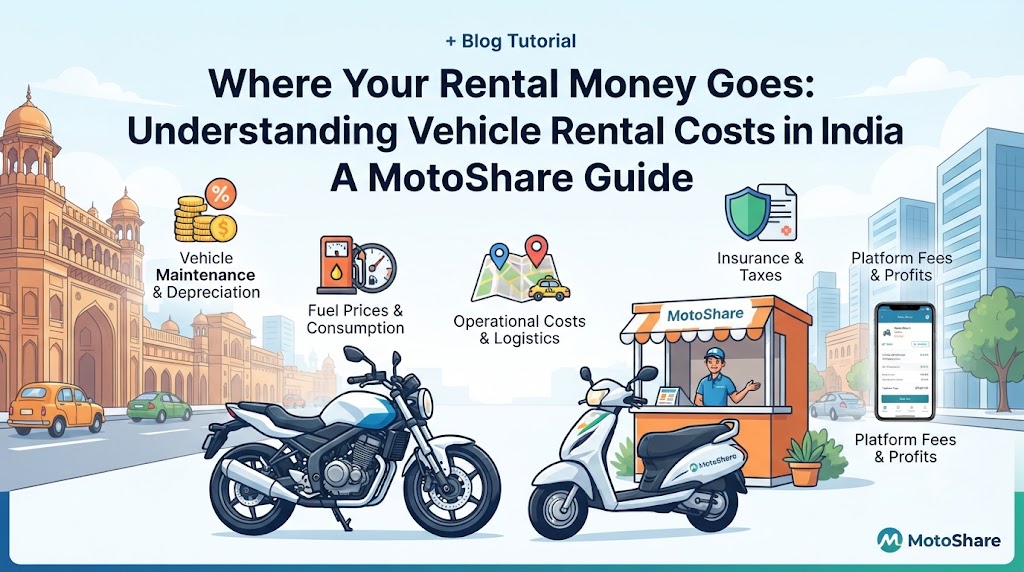
A daily rate is rarely the whole price. A rental bill is closer to a recipe: the base rent is only one ingredient, and the deposit, fuel, tolls, extra distance, and fees all change what you actually pay. People who only compare the headline number are the ones who feel surprised at the end of a trip.
This matters whether you are a student renting a scooter for a month, a tourist planning a weekend ride, or a professional hiring a car for a short work visit. Bike rental in India and car rental in India both offer a wide range of vehicles, and the cheapest-looking listing is not always the cheapest one to use.
This guide breaks a rental bill into its parts, compares what different vehicle types tend to cost to use, and gives you a simple worksheet for budgeting. It uses MotoShare as an example of an online rental marketplace, but the advice works on any platform.
What MotoShare Is and How It Fits In
MotoShare describes itself as a marketplace that connects people who need a vehicle with local rental providers. Its description mentions motorcycles, scooters, cars, and bicycles, searches by city, a choice of rental periods, and online booking. It also refers to verified local providers.
For a cost-minded renter, the useful point is that a marketplace lets you look at several providers side by side. The limit is that a description cannot tell you the price, the deposit, or the rules of a particular listing. Those depend on each provider and can change with the season and the dates. Treat the live listing as the source of truth, and ask the provider about anything that is not clear.
Why Renting Can Make Sense From a Cost View
Think about what owning a vehicle involves: the purchase, registration, yearly insurance, servicing, repairs, parking, and the money tied up in a vehicle that loses value over time. If you use it every day, those costs are spread over many trips. If you use it a few times a year, each trip becomes expensive.
Renting turns those fixed costs into a cost you pay only when you need a vehicle. It also lets you match the vehicle to the trip instead of owning one that is wrong for half your journeys.
Be honest about the limits too. For daily use over many months, owning often costs less. Peak seasons can raise demand and reduce choice. And a deposit locks up some of your money for a while, even though it is returned later if all goes well.
The Anatomy of a Rental Bill
Here are the pieces that usually make up the total.
Base rent
This is the price for the rental period, shown per hour, day, week, or month. Check what the period actually means. A “day” may be 24 hours from pickup, or it may end at a fixed time in the evening.
Deposit
The deposit is money held as security and returned after the rental if there is no damage or unpaid charge. It is not a cost in itself, but it affects your budget, so ask three things: how much it is, when it comes back, and what can be taken from it.
Fuel
Fuel is usually your cost. Ask about the fuel policy: should you return the vehicle with the same fuel level you received, or does the provider refill it and charge you? Scooters and small motorcycles generally use less fuel than larger bikes and cars, though the exact figures depend on the vehicle and the way you ride.
Tolls and parking
For cars especially, tolls and parking can add up on longer trips. Ask whether the vehicle is set up for electronic toll payment and how those charges are handled.
Distance charges
Some rentals include a daily distance cap and charge extra beyond it. A low rate with a low cap can become expensive on a long ride. Check the cap against your planned route.
Taxes and service fees
Taxes and platform or service fees may be added at the end. Ask whether the price you see includes them.
Insurance and damage share
Third-party insurance is a legal requirement for vehicles in India. But it does not necessarily cover damage to the rental vehicle itself. Ask what the policy covers, and ask how much of a repair bill you would pay yourself if the vehicle is damaged.
Change, cancellation, late, and damage charges
Read the rules for cancelling or changing dates, since refunds can depend on how early you act. Late returns can be charged by the hour or as a full extra day. Damage charges are easier to settle if you photographed the vehicle’s condition at pickup.
Which Vehicle Costs What to Use, in Practical Terms
This section compares general patterns, not actual prices.
Scooters. Scooter rental in India is often the easiest on the budget for city use. Scooters are light, automatic, and usually economical on fuel. The trade-off is limited luggage space and low power on hills with two people.
Standard motorcycles. These are a balanced choice for commutes and weekend rides. They need some comfort with gears, and they tend to cost more to rent than a basic scooter.
Premium or performance bikes. These usually cost more to rent, often need a larger deposit, and can be expensive if damaged. They also demand more riding experience.
Adventure bikes. These are built for long distances and rough roads. They tend to be tall and heavy, and they cost more to rent and to fuel over long trips.
Cars. A self drive car rental India listing means you drive the car yourself instead of hiring a taxi with a driver. A car costs more per day than a scooter. Fuel, tolls, and parking add to the total, but a car can make sense for groups, luggage, and rain, since the cost is shared among passengers.
Bicycles. A bicycle is usually the lowest-cost option. It suits short, flat sightseeing, but heat and hills can make it hard work.
Likewise, a self drive bike rental means you ride the bike yourself. That gives you freedom over time and route, and it also makes you responsible for the vehicle and any damage.
Short Rentals and Long Rentals: How the Costs Shift
For a few hours or a day, the base rent and the distance cap matter most. Watch for strict return times, because lateness can add a charge.
For a week or a month, the daily rate may be lower, but the deposit may be higher. New costs and questions also appear: who pays for servicing, what happens in a breakdown far from the pickup point, and whether you can extend at the same rate. If your plans might change, ask about early return and cancellation terms before you commit to a longer period.
Finding Options Without Overspending
A good search is organised. Start with the city where you will pick up the vehicle, then enter exact dates and times, the vehicle type, and the rental period.
Many people begin with a phone search such as bike rental near me, which is a sensible way to find a pickup point close to where you are staying. Check the address on a map, and ask whether delivery is possible and whether it costs extra.
When you rent a bike online, you can compare several providers, view photos, and read the terms before you pay. Compare at least three listings on total cost, not just the daily rate. Remember that photos may be old and a vehicle may not be free on your dates. MotoShare describes online booking, so check the exact steps and terms of the listing you choose, and keep your messages and receipts.
Cost Notes for Four Kinds of Renters
Tourists should budget for fuel, parking, and a possible deposit, and should keep a small buffer for extra distance. A simple, easy-to-handle vehicle saves money on mistakes.
Commuters should compare weekly and monthly terms, and ask how servicing and breakdowns are handled, since a vehicle used every day needs regular care.
Students should look for a deposit they can afford and a vehicle that is cheap to run. Check age and licence rules before you plan the budget.
Professionals should ask whether they can get a proper invoice for an expense claim, and should consider how much time a reliable vehicle saves.
City Cost Notes: Goa and Bengaluru
These notes are general. They do not say what any platform lists today, so always check live listings.
Budgeting a Two-Wheeler Trip in Goa
Goa gets busy during holiday weeks, and demand can affect both choice and price, so book early if your dates are fixed. People who search for bike rental in Goa often want a light scooter or a modest motorcycle for short hops. Ask about the distance cap, the fuel policy, and the deposit, and budget for parking in crowded areas. Carry your licence and vehicle papers, and wear a helmet.
Budgeting Daily Transport in Bengaluru
Bengaluru’s busy roads make a light vehicle easier to manage. For people looking at bike rental in Bangalore for commuting, the comparison is usually between weekly and monthly terms, plus servicing and the size of the deposit. Fuel and parking add to the monthly total, so it helps to estimate your daily distance first. For a weekend trip out of the city, check the distance cap, since a highway day uses far more distance than errands in the neighbourhood.
The Bigger Picture: Regional Marketplaces Across Asia
Motorcycles and scooters are everyday transport in many Asian countries. A traveller planning a longer journey may search for motorcycle rental Asia and find costs presented in very different ways: different currencies, different deposit habits, and different tax and fee styles. A regional marketplace could make comparison easier by showing local providers in a familiar layout, so that costs and terms line up from one place to the next.
MotoShare’s description points to opportunities across India and other Asian destinations. Treat that as a direction, and check where it operates today. Remember that each country has its own rules for licences, permits, helmets, and insurance, and that taking a rented vehicle across a border is often restricted.
A Simple Budget Worksheet
Before you book, write down these lines. Use the numbers from the listing and the provider’s answers.
- Base rent multiplied by the number of days
- Taxes and service fees
- Fuel estimate for your route
- Tolls and parking
- Distance charges, if your route may pass the cap
- Insurance or damage-share costs you may face
- Deposit (refundable, but money you must have available)
- A small buffer for the unexpected
Add the lines, and compare the total across listings. If a provider cannot answer one of these lines, that is a signal to ask more questions.
Five Steps From Budget to Booking
- Choose your destination and note your route, dates, group size, and luggage.
- Check availability for those exact dates near your pickup point.
- Compare terms and total prices using the budget worksheet.
- Review the documents you need, such as your licence, identity proof, and payment method.
- Confirm the booking in writing, and photograph the vehicle at pickup.
Costly Mistakes to Avoid
Comparing only the daily rate. Add up the full bill for your own dates and distance.
Ignoring the deposit policy. Ask the amount, the refund time, and what can be deducted, and make sure you can afford to have that money held.
Overlooking insurance terms. Legal insurance does not always cover damage to the rental. Ask what you would pay.
Skipping the condition check. Without photos at pickup, damage charges are hard to dispute. Photograph every side and check the tyres, brakes, and lights.
Leaving pickup and return rules vague. A missed time or wrong place can add charges. Get the details in writing.
A Hypothetical Example: Four Colleagues, One Offsite Weekend
Neha, Vikram, Anita, and Joseph are planning a weekend offsite a few hours from their city. They are weighing a self-drive car against booking two cabs for the round trip. They want to know which choice makes sense and how to split the cost.
They list the budget lines. For the car, they note the base rent for two days, the fuel for the round trip, the tolls, and the parking at their destination. They also note the deposit, which one person would have to pay up front. For the cabs, they get a single quote that includes the driver and the tolls.
Vikram holds a valid licence and is willing to be the named driver, so they ask the provider whether other people can drive and what the insurance covers. They also check the distance cap against the route. They find that the car works out well for four people with luggage, because the cost is shared. The cabs would cost more for the group and make timing harder.
They decide on the car. They agree in advance that Vikram is the named renter, that the deposit will be shared and returned to whoever paid it, and that fuel and tolls will be tracked on a shared list and split at the end. They photograph the car at pickup and save the booking confirmation.
Questions About Rental Costs
Why does a listing with a low rate sometimes end up costing more?
Extras often explain the gap: a low distance cap, fuel charges, fees, taxes, or a high damage share. Ask for the total for your dates and distance.
Is fuel included in the price?
Not usually. Ask about the fuel policy and what level of fuel to return the vehicle with.
Are tolls and parking my cost?
Generally yes. For cars, ask how tolls are handled, and keep any receipts.
Is a weekly or monthly rate always cheaper per day?
Not always. It can be, but it may come with a larger deposit and a longer commitment. Compare the full terms.
Can friends split a rental?
In practice, yes. But one person is usually the named renter and is responsible for the terms and the deposit. Agree in advance how the costs and any damage will be shared.
How do I keep records for an expense claim?
Save the booking confirmation, the receipt, and any fuel and toll receipts. Ask the provider whether a proper invoice is available.
What if the final charge is different from the quote?
Ask for an itemised breakdown and compare it with your written confirmation. Photos from pickup and return help settle any damage charge.
Conclusion
A rental is easier to manage when you think in totals. Look at the base rent, the deposit, fuel, tolls, extra distance, and insurance terms together, and compare the full bill, not just the first number you see.
Whether you rent a bike online for a weekend, compare cars for a group trip, or plan a longer journey across Asia, a short worksheet and a few clear questions can save money and stress. A marketplace such as MotoShare can bring local options together, but the budgeting is yours to do. Bike rental in India, car rental in India, and travel across the region all go better when the total is clear before you book.